
Understanding SAE J3072, UL 9741 and UL 1741 Supplement SC for Bidirectional EV Charging – Part 2
09 Nov 2026
Two Certification Pathways for V2G Using UL 9741 Certified Bidirectional AC EVSEs and Onboard EV Inverters: SAE J3072 + UL 1741 Supplement SC-Based and Evaluation as DER
As vehicle-to-grid (V2G) applications gain momentum, the industry is converging around two distinct certification philosophies for AC bidirectional charging systems using onboard EV inverters. . The second is an emerging concept that treats the onboard EV inverter as a conventional distributed energy resource (DER) inverter certified directly to UL 1741 Supplement SB, with the EVSE serving only as Interconnection System Equipment (ISE).
Both approaches aim to facilitate safe and interoperable export of energy from EV batteries to the grid, but they differ significantly in how responsibilities are allocated between the vehicle and the charging equipment.
Pathway 1: SAE J3072 + UL 1741 Supplement SC
The current North American V2G-AC framework was developed specifically to address vehicles equipped with onboard bidirectional inverters. In this model, the EV does not function as a standalone certified DER. Instead, the EV inverter is certified to SAE J3072 which incorporates the grid interconnection requirements and UL 1741 supplement SC on EV supply equipment (EVSE) provides oversight supervisory control between the vehicle and the EVSE.
The architecture can be represented as:

The EVSE acts as an "oversight supervisor," managing grid interconnection, protection coordination, and system supervision, while the vehicle supplies the inverter functions required for exporting power. When authentication handshake happens between EVSE and EV, correct regional grid setting is transferred from EVSE to EV.
(1): BVSE: Bidirectional EVSE
Certification Components
Vehicle
The onboard inverter is evaluated according to SAE J3072, which establishes requirements for utility-interconnected vehicles equipped with bidirectional onboard inverters.
Typical evaluations include but not all:
- Anti-islanding
- Voltage ride-through
- Frequency ride-through
- Grid support functions
- Utility interconnection behavior
EVSE
The EVSE is certified under UL 1741 Supplement SC, a standard developed specifically for bidirectional EVSE applications interacting with SAE J3072-compliant vehicles.
Functions include but not all:
- Export supervision
- Utility interface
- Protection coordination
- Fault management
- Disconnect control
Communications
Interoperability is typically supported through ISO 15118-20, enabling bidirectional power transfer control, DER services, and Plug & Charge functionality.
Advantages
Designed for Mobile DERs
The framework was specifically created to address the challenges of a DER that can move between locations and utility territories.
Regulatory Momentum
Utilities and regulators are already developing interconnection procedures around the J3072/SC model. Several jurisdictions have identified certification pathways using these standards.
Reduced Vehicle Certification Burden
Not all DER functionality must reside solely within the vehicle. Certain supervisory functions can be delegated to the EVSE.
Pathway 2: Direct DER Certification of the Onboard Inverter
An alternative approach is to certify the onboard EV inverter exactly as any stationary DER inverter, using the existing DER framework centered on UL 1741, UL 1741 Supplement SB, and IEEE 1547.
In this model:

Plain Text
The onboard EV inverter becomes the DER.
The EVSE functions only as interconnection system equipment which can or does not share any grid functions, analogous to switching, isolation, metering, and communication and interoperability infrastructure.
Certification Components
Vehicle Onboard Inverter
The inverter would typically undergo the same type-testing expected of stationary DER equipment but some of these functions could be done by EVSE acting as ISE:
- Anti-islanding
- Voltage ride-through
- Frequency ride-through
- Volt-VAR
- Volt-Watt
- Frequency-Watt
- Enter-service functions
- Cease-to-energize functions
The vehicle effectively becomes a portable inverter.
EVSE
The EVSE would be evaluated as ISE rather than as a DER or supervisory controller.
Functions could include but not all:
- IEEE 1547 interoperability
- Isolation
- Contactors
- Ground-fault protection
- Metering
- Communication gateway
- Disconnect means
Required Pairing Certification
A common misconception is that direct DER certification eliminates the need for vehicle-EVSE pairing.
In practice, system-level validation would still be required. The inverter must verify that:
- Export-capable EVSE is present
- Protection assumptions remain valid
- Communication protocols operate as intended
- Disconnect functions are coordinated
As a result, certification reports would likely document approved EV and EVSE combinations.
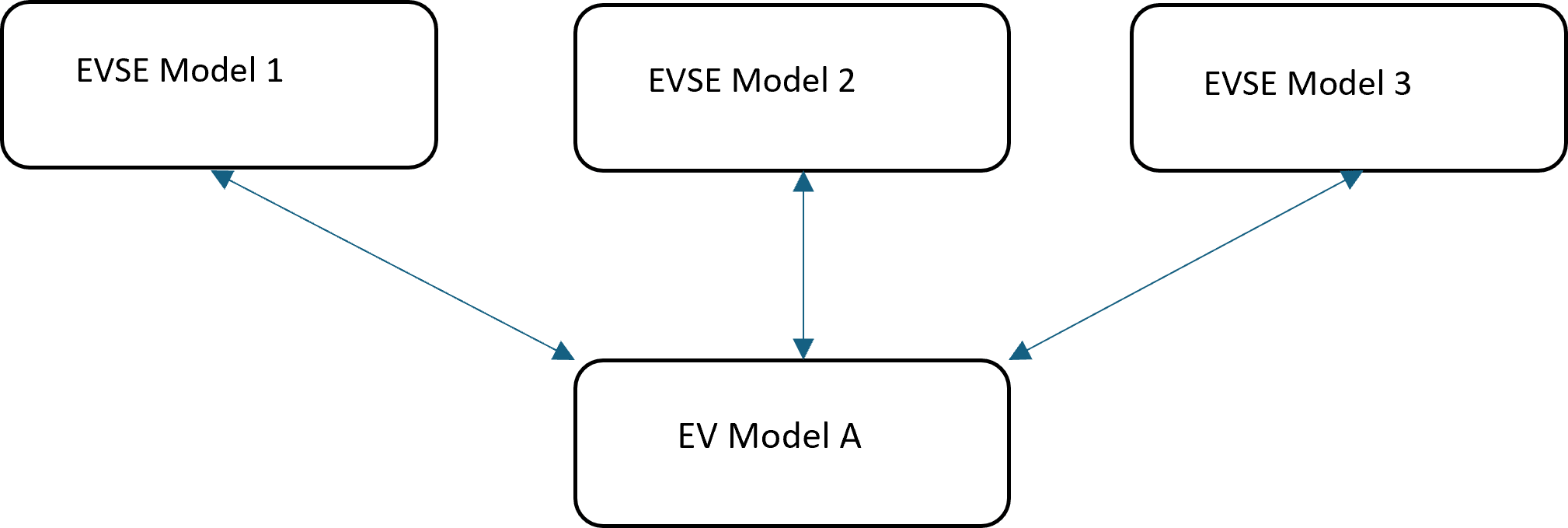
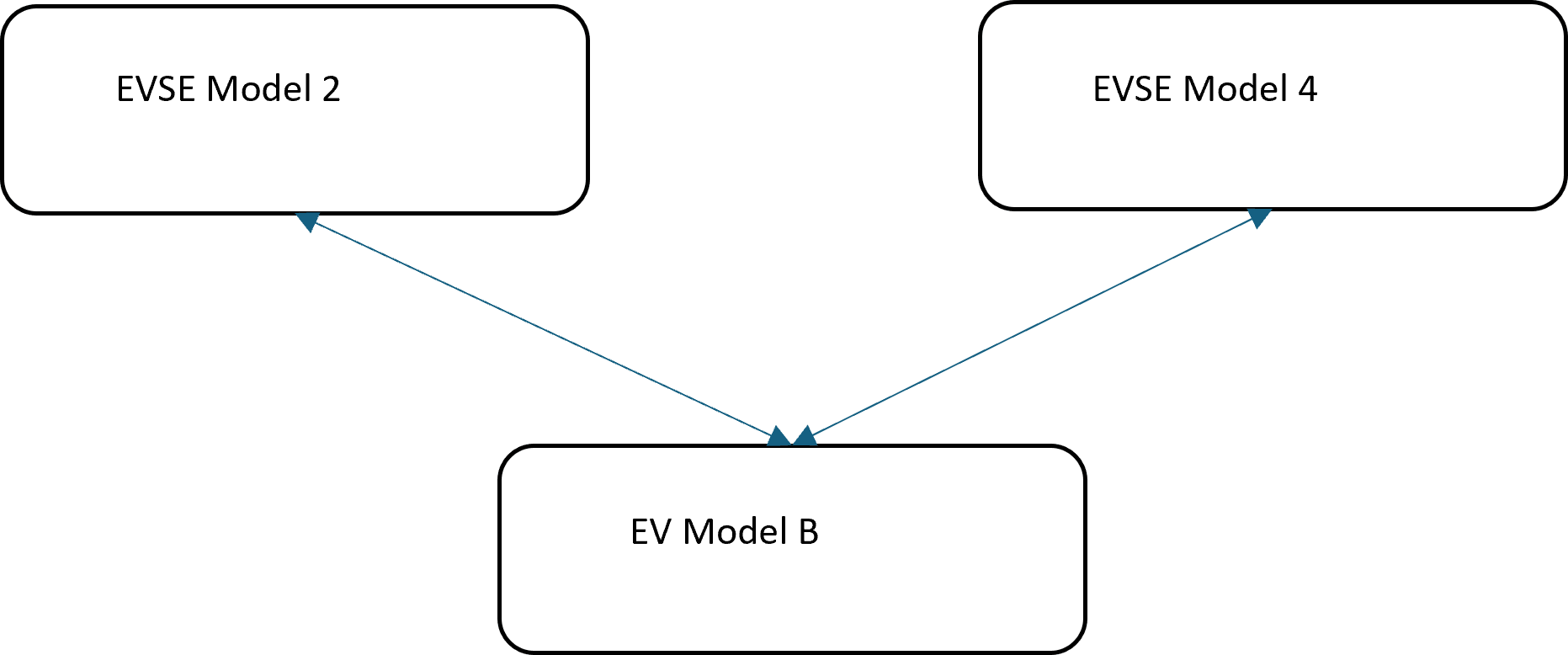
This resembles existing multipiece DER certification practices used elsewhere within the distributed energy industry.
Advantages
Familiar Utility Framework
Utilities are already comfortable with:
- IEEE 1547
- UL 1741
- UL 1741 Supplement SB
The vehicle inverter simply becomes another DER asset.
Clear Functional Ownership
DER Functions → Vehicle
Interconnection Functions → EVSE
This separation can simplify certification responsibilities.
Technology Neutrality
The approach avoids specialized automotive interconnection standards and leverages existing DER certification infrastructure.
Challenges
Mobile DER Governance
The primary challenge is no longer inverter performance.
Instead, it becomes an interconnection management issue:
- Who owns the DER?
- Which utility territory is it operating in?
- How is registration managed?
- How are firmware updates controlled?
These questions become significantly more complicated when a certified DER can move between service territories daily.
Pairing Requirements Remain
Although the DER is independently certified, utilities and certification bodies may still require approved EV-EVSE combinations to demonstrate proper interoperability and protection coordination.
Side-by-Side Comparison
| Topic | SAE J3072 + UL 1741 SC | Direct DER Certification |
| DER certification location | Split between EV and EVSE | Split between EV and EVSE |
| EVSE role | Oversight Supervisor (BEVSE) | Interconnection System Equipment (ISE) |
| Vehicle standard | SAE J3072 | UL 1741 SB / IEEE 1547 |
| EVSE standard | UL 1741 SC | Evaluation as ISE |
| Utility acceptance | Specifically designed for mobile DERs | Uses familiar DER certification model |
| Pairing requirements | SAE J3072 approved EV can be connected to any UL 1741 supplement SC certified EVSE provided proper EV connector is used | Required with specific EV and EVSE combination tested and reported |
| Functional ownership | Shared | shared |
| Power Export Safety of Bidirectional EVSE | UL 9741 | UL 9741 |
| Long-term interoperability | Based on SC/J3072 ecosystem | Based on DER interoperability framework |
Conclusion
The industry today is moving primarily through the SAE J3072 and UL 1741 Supplement SC pathway because it was specifically developed to address the unique challenges associated with mobile DER assets and vehicle-based power export.
However, a compelling alternative exists: treating the onboard inverter as a conventional DER evaluated directly to UL 1741 Supplement SB and IEEE 1547, while considering the EVSE as ISE. Under this approach, the EV effectively becomes a portable DER asset, with interoperability maintained through certified EV-EVSE pairings documented in certification reports.
As V2G markets mature and interoperability standards such as ISO 15118-20 evolve, the industry may ultimately converge toward a hybrid model where certified DER vehicles and certified EVSEs interact through standardized interfaces, minimizing pairing dependencies while preserving utility confidence and grid safety.

You may be interested in...

Bidirectional EVSE Charging: Technical FAQs for V2L and V2X Systems
Download our technical FAQ on V2L and V2X technologies, including high power charging, UL 9741 standard compliance, interoperability, safety, cybersecurity and testing considerations

EVSE Testing & Certification
Intertek offers Electric Vehicle Supply Equipment (EVSE) Testing and Certification solutions validating electric vehicle charging systems and the safety of EV-related products.